
Ever feel like the rules and regulations of today are a bit… much? Well, take a trip back in time with us, and you might just find yourself grateful for modern common sense. History is absolutely packed with laws that range from the utterly baffling to the downright hilarious (and sometimes, sadly, quite cruel).
Forget speeding tickets; imagine getting fined for eating ice cream on a Sunday, or having your beard forcibly shaved for crying in public! Let’s dive deep into some of the strangest legal quirks our ancestors cooked up.
The Cruel Reality of “Ugly Laws”

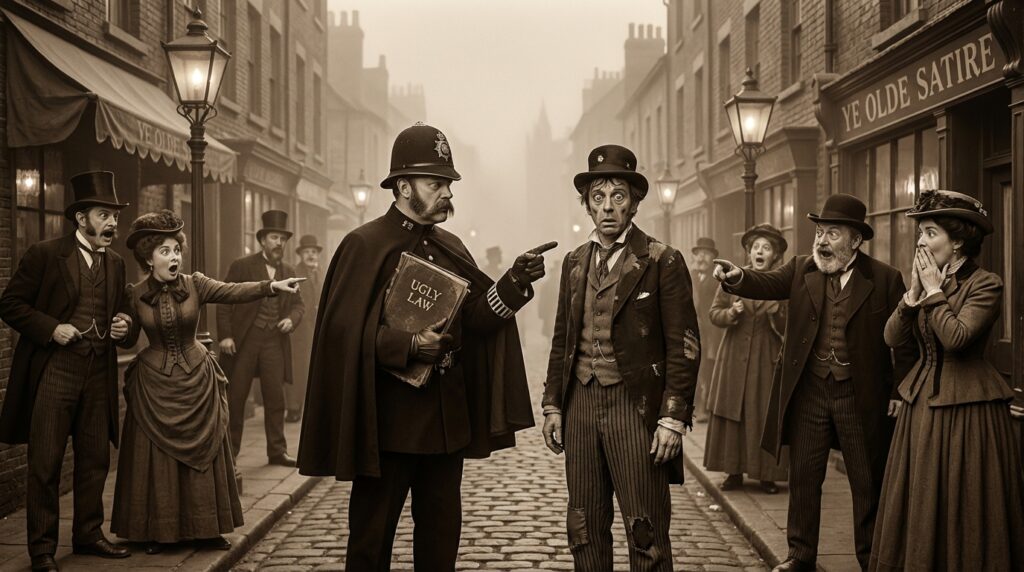
While many old laws are amusing, some serve as a chilling reminder of past prejudices. Perhaps one of the most shocking and inhumane examples from American history are the so-called “Ugly Laws.” From the 1860s all the way up to the 1970s, several major US cities had ordinances that made it illegal for people with “unsightly or disgusting” disabilities or deformities to appear in public spaces.
This wasn’t just a social taboo; it was codified law. Cities like Chicago, San Francisco, and New Orleans enforced these statutes, effectively banishing a whole segment of the population from public life. The first recorded arrest under such a law occurred in San Francisco in 1867, targeting a man named Martin Oates. The language of these laws was blunt and cruel, aiming to keep anyone who didn’t fit a narrow standard of appearance out of sight. It wasn’t until the rise of the disability rights movement that these laws were finally challenged and repealed, with Chicago being the last city to strike its “ugly law” from the books in 1974.
The Great English Football Ban

Long before the Premier League, football in medieval England was a chaotic, violent affair, often involving entire villages brawling over an inflated pig’s bladder. Kings like Edward II and Henry V saw it as a public nuisance and, more importantly, a distraction from the much more militarily useful practice of archery. Several royal proclamations were issued banning the game entirely, with the threat of imprisonment for anyone caught playing.
The Sinful Scoop: Ice Cream and the Sabbath

As mentioned, the late 19th and early 20th centuries saw the rise of “Blue Laws” in America, designed to enforce religious observance on Sundays. While you probably wouldn’t be arrested for eating ice cream, selling “soda water” or other “frivolous” treats was often forbidden. This led directly to the ingenious creation of the ice cream sundae—a scoop of ice cream with syrup, but without the sinful soda. It was a delicious act of rebellion against a truly bizarre restriction.
Sumptuary Laws

Medieval and Renaissance Europe was obsessed with social hierarchy, and sumptuary laws were designed to keep it that way. These laws dictated exactly what people of different classes could wear. A peasant caught wearing silk, purple dye (reserved for royalty), or certain types of fur could face severe penalties. In England, for example, only the nobility were permitted to wear cloth of gold or silver. These laws weren’t just about fashion; they were about enforcing a rigid social order.
Peter the Great’s War on Beards

In the late 17th and early 18th centuries, Tsar Peter the Great of Russia was determined to modernize his country and align it with Western Europe. To him, the long, traditional beards worn by Russian men were a symbol of backwardness. His solution? A beard tax. If you wanted to keep your facial hair, you had to pay up and carry a special token as proof. Those who refused could have their beards forcibly and often painfully shaved. It was a dramatic and deeply unpopular policy, but it showed how serious Peter was about changing Russia’s image.
An Eye for a Cabbage?
The Code of Hammurabi (c. 1754 BC) is famous for its “eye for an eye” principle, but it applied to more than just personal injury. It held builders brutally accountable: if a house collapsed and killed the owner, the builder was executed. If the owner’s son died, the builder’s son was killed. The code also took religious purity to extremes: any priestess who so much as entered a tavern was to be burned alive.
The Original “Draconian” Law
In 7th century BC Athens, the lawmaker Draco created a legal code so severe that his name gave us the word “Draconian.” Under his laws, almost every crime was punishable by death. Stealing a cabbage or an apple carried the same penalty as murder. While intended to end blood feuds by making the state the arbiter of justice, its extreme harshness was legendary even in the ancient world.
No Beans for You!

Ancient Rome also had its share of strange rules. The Flamen Dialis, the high priest of Jupiter, lived under a bizarre set of restrictions. He was forbidden from touching iron, riding a horse, or even looking at a dog or a goat. Most famously, he couldn’t touch or even mention beans, possibly because they were associated with the dead. The rules were so burdensome that the position once sat vacant for 75 years.
These historical oddities are more than just trivia. They are a window into the values, fears, and priorities of past societies. They show us how ideas of justice, morality, and social order have changed over time, and they certainly make our modern legal systems seem a little less strange by comparison.
References
National Geographic | Wikipedia | Street Spirit | English Heritage | History.co.uk | History Today