
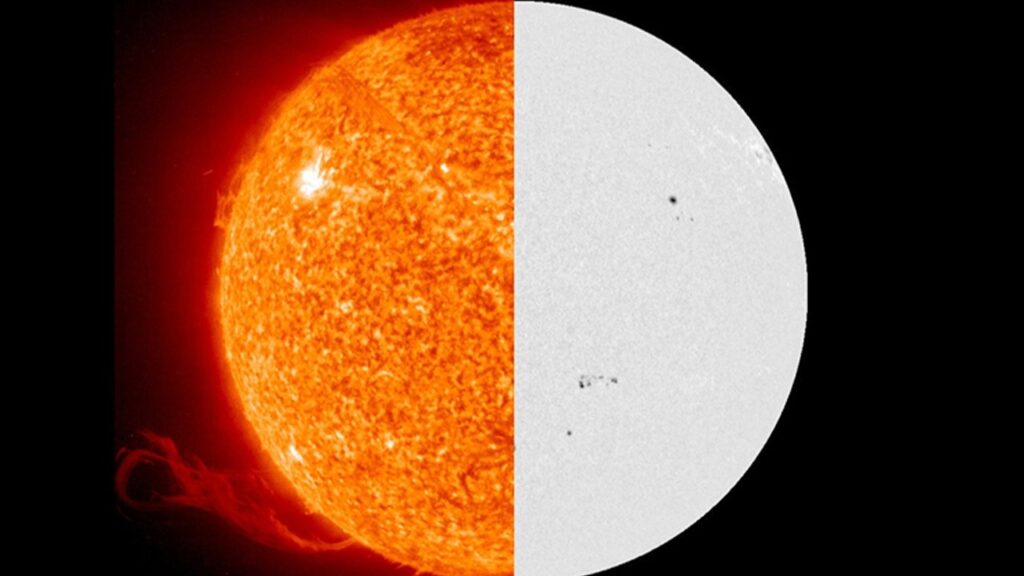
If you open a box of crayons and ask a five-year-old to draw the sky, they will almost instinctively reach for two colors: Cornflower Blue for the sky and Dandelion Yellow for the Sun.
We carry this image with us into adulthood. We see the golden hour; we watch fiery orange sunsets; we look up (briefly!) at a yellow orb in the heavens. But here is the uncomfortable truth: The Sun is not yellow.
Here is the story of why our eyes lie to us, and the physics that paints our sky.
See More: Mother Finds Heartwarming Grave Secret
The Prism of the Sky

To understand the Sun’s true color, we have to look at the data hidden in light itself.
Isaac Newton famously used a prism to show that white light isn’t actually “white”, it is a combination of every color in the visible spectrum.
The Sun is essentially a massive thermal radiator. According to the laws of physics (specifically Wien’s displacement law), a star of the Sun’s temperature (about 5,500°C at the surface) peaks in the blue-green part of the spectrum.
However, it emits enough light across all visible wavelengths, from violet to red, that our eyes perceive the mix as white.
So, why don’t we see a white ball in the sky?
See More: Don’t Eat That Watermelon If You See This
The Atmospheric Filter
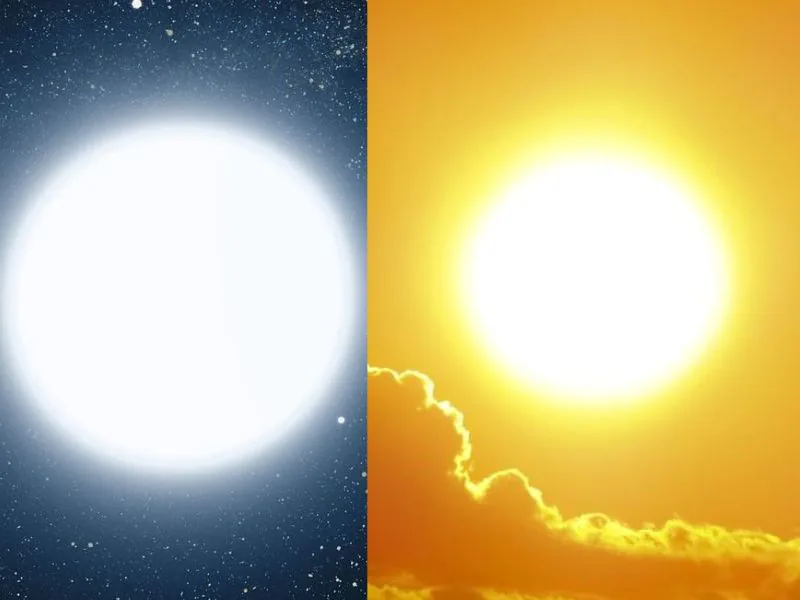
The reason we do not see a white Sun from the ground is our atmosphere. When sunlight hits the Earth, it collides with a thick layer of nitrogen, oxygen, and other tiny particles.
This collision creates a phenomenon known as Rayleigh Scattering.
Sunlight travels in waves. The shorter waves, like blue and violet light, crash into gas molecules and scatter in every direction.
This scattered blue light is what colors the sky above us. The longer waves, like yellow, orange, and red, pass through the atmosphere more easily. They travel on a straighter path directly to your eyes.
The Sun looks yellow to us simply because the atmosphere has scattered away the blue light before it reaches you.
See More: Woman Turns Old Boeing 727 Into Luxury Home
Evidence From the Void
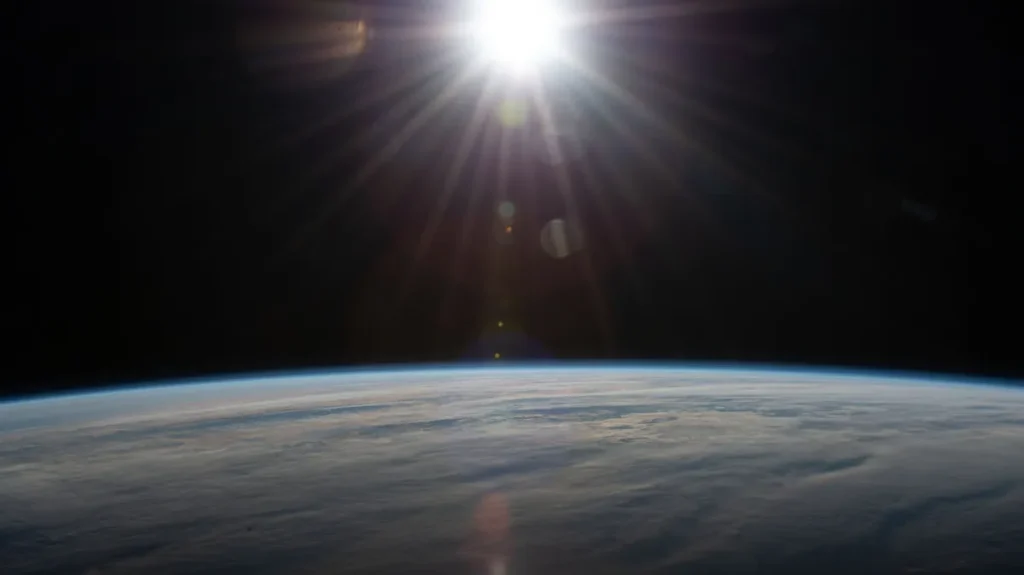
The most definitive proof comes from astronauts. Those who travel aboard the International Space Station describe the Sun very differently than we do.
Without the atmosphere to filter the light, they see the Sun as a sharp and intense sphere of pure white.
You can also see this in raw images from space agencies. While many public photos are color corrected to look yellow or orange for aesthetic reasons, the raw data shows a white star. The yellow Sun is purely a planetary experience.
See More: Tennis Balls Became Tiny Homes for Mice
The Sunset Effect
The atmosphere alters the color of the Sun most dramatically at sunset. When the Sun is low on the horizon, its light must travel through a much thicker layer of the atmosphere to reach you.
This path is so long that the atmosphere scatters away the blue light and even the green and yellow light.
The only waves that survive this long journey are the longest ones. These are the deep oranges and reds that characterize a sunset.
The next time you see a golden Sun, remember that you are viewing a white star through a blue filter.