
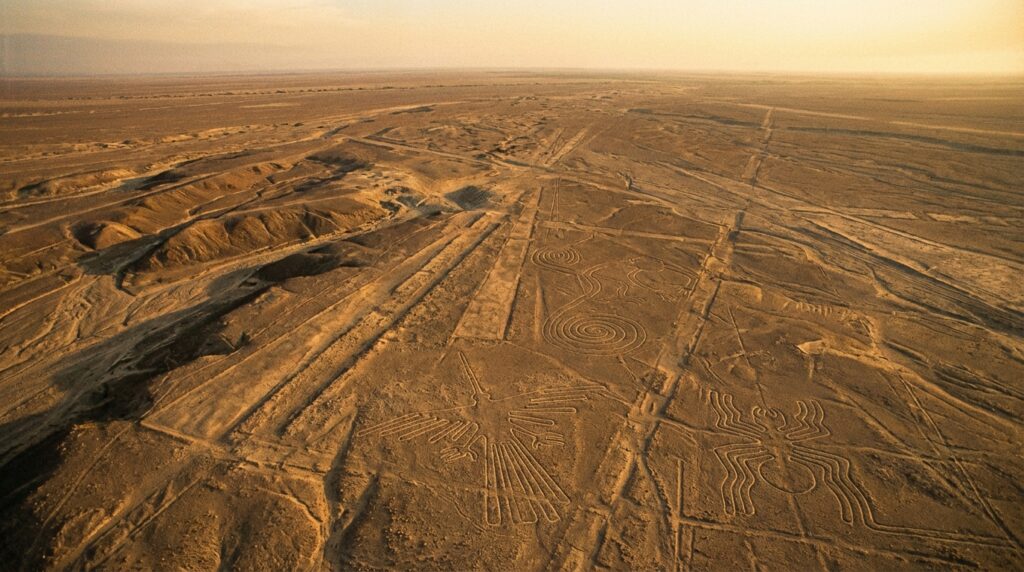
Imagine walking through one of the driest places on Earth, a barren, windswept plateau in southern Peru. For miles in every direction, there is nothing but reddish-brown rock and sand. But then, you look up, from a plane, a drone, or even just a satellite image, and the desert floor transforms.
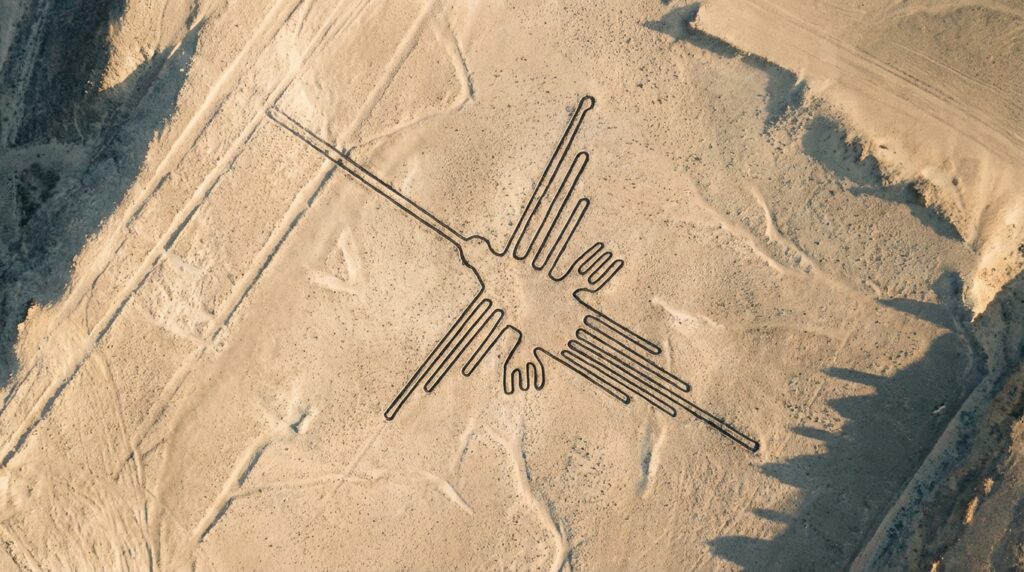
Etched into the landscape are hundreds of gigantic, perfect drawings: a 150-foot spider, a 300-foot hummingbird with a long, delicate beak, a massive monkey with a spiraling tail, and colossal geometric shapes that stretch for miles. These are the Nazca Lines, one of archaeology’s most profound and enduring mysteries. For nearly a century, we’ve known they were there. But the two questions that have haunted scientists, historians, and dreamers alike remain: How did they do it? And more importantly, why?
How Were the Lines Made?
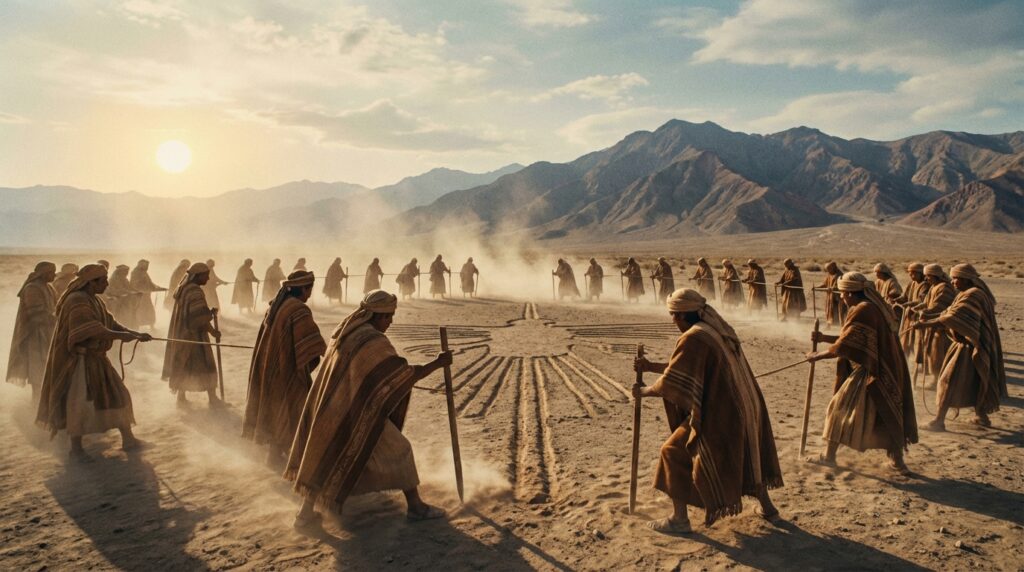
For artworks of such monumental scale and precision, the method of their creation is surprisingly simple, yet ingenious. The Nazca desert floor is covered with a layer of iron oxide-coated pebbles, which have a dark, reddish-brown color. The ancient Nazca people, who flourished in the region between 500 BC and 500 AD, discovered that by simply removing this top layer of rock, they could expose the lighter-colored, sandy soil underneath.
Using basic tools, likely wooden stakes and lengths of rope, they were able to create perfectly straight lines, some running uninterrupted for miles, and complex, curvilinear figures with incredible accuracy. The dry, windless, and stable climate of the Nazca plateau has preserved these delicate drawings for nearly two thousand years, creating a massive, open-air art gallery. The real mystery isn’t the engineering, but the motive.
The Purpose
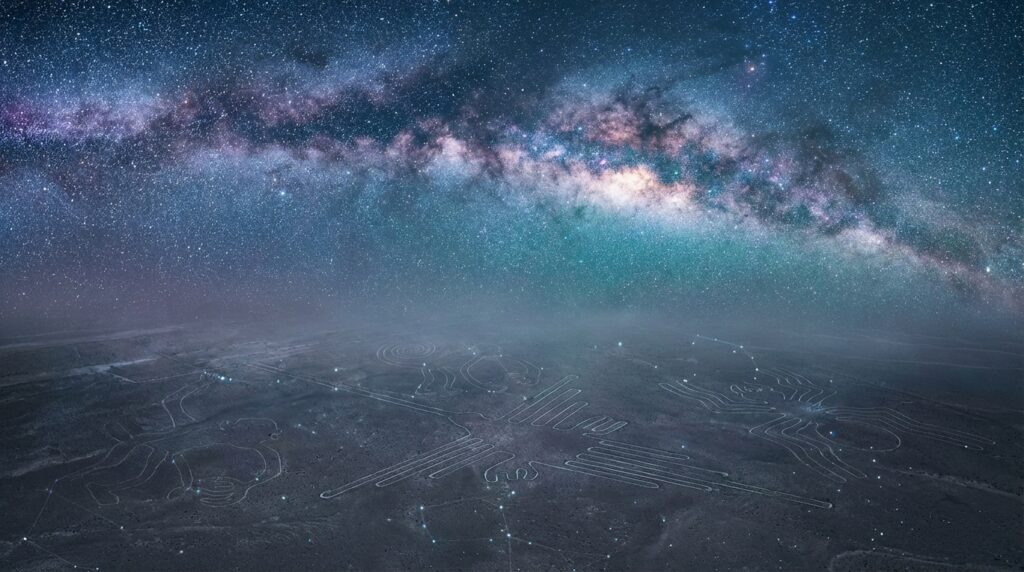
Because the figures can only be truly appreciated from high above, theories about their purpose have ranged from the plausible to the fantastically bizarre. Early, sensationalist ideas proposed they were landing strips for alien spacecraft, a theory that has been thoroughly debunked by the scientific community. The real answers, while less extraterrestrial, are no less fascinating.
Theory 1: A Map of the Heavens
The first major scientific theory was championed by German mathematician and archaeologist Maria Reiche, who dedicated her life to studying and preserving the lines. She proposed that the geoglyphs constituted a vast astronomical calendar. The lines, she argued, aligned with the rising and setting of the sun, moon, and specific stars during important times of the year, like the solstices. Some of the animal figures were thought to represent constellations. While some alignments have been found, later research showed that the vast majority of lines have no connection to celestial events, suggesting this wasn’t their primary purpose.
Theory 2: A Prayer for Water
Perhaps the most widely accepted theory today centers on the most precious resource in the desert: water. Archaeologists believe the Nazca Lines were created as part of elaborate rituals to petition the gods for rain and fertility. The lines often lead to ceremonial sites, and many of the animal figures, like spiders (thought to be a sign of rain), hummingbirds, and monkeys, are associated with water and fertility in Andean mythology. The geoglyphs weren’t necessarily meant to be seen by humans on the ground, but by the gods in the sky. They were, in essence, giant prayers etched into the earth.
Theory 3: Processional Pathways
Building on the ritual theory, some researchers believe the lines themselves were the sites of the rituals. Instead of being pictures to look at, they were ceremonial pathways to be walked. Different families or clans may have been responsible for maintaining specific lines and figures, walking them in procession during religious ceremonies to connect with their deities and the sacred landscape.
AI and Drones Join the Hunt
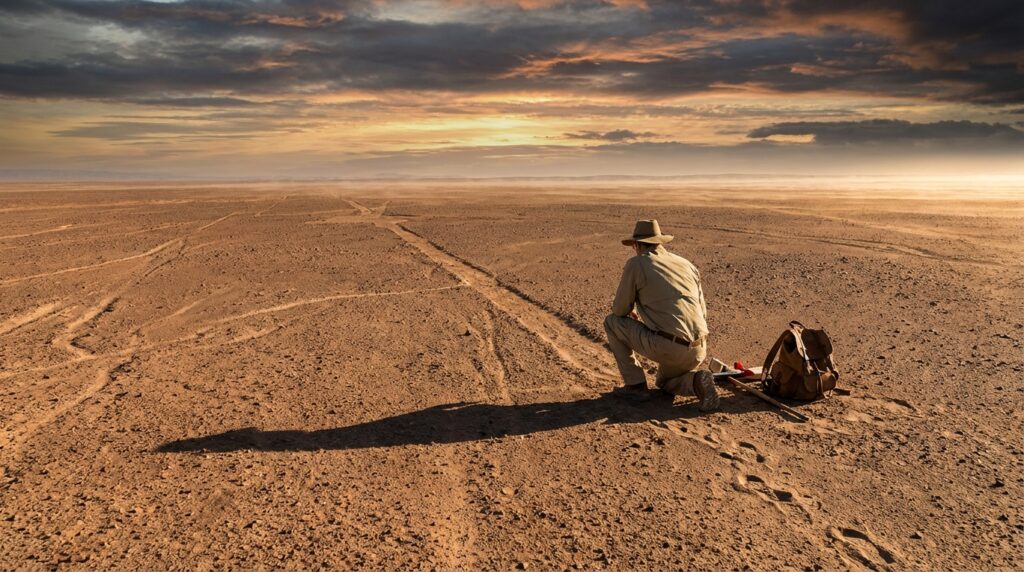
For decades, the known collection of Nazca geoglyphs remained relatively static. But in recent years, technology has blown the field wide open. Using high-resolution drone imagery and, most recently, artificial intelligence, archaeologists are discovering hundreds of previously unknown figures, rewriting our understanding of this ancient culture.
In a groundbreaking study in 2024, a team from Yamagata University in Japan, in collaboration with IBM Research, used an AI deep learning model to analyze drone footage of the Nazca region. In just six months, the AI identified 303 new geoglyphs, nearly doubling the number of known figures in a fraction of the time it took to find the first few hundred.
These newly discovered drawings are often smaller and fainter than the iconic figures, and many belong to an even earlier period (dating back to 200 BC), suggesting they were made by the Nazca’s predecessors, the Paracas culture. They depict a fascinating array of subjects: parrots, cats, snakes, killer whales, and even gruesome scenes of humans holding decapitated heads.
According to Peruvian archaeologist Johny Isla, these smaller, older figures were likely “made by humans for humans.” Unlike the giant figures meant for the gods, these could have served as trail markers, landmarks, or symbols for specific families or groups, walked and viewed at ground level. This suggests the purpose and audience of the geoglyphs evolved over centuries.
The Enduring Enigma
With every new discovery, the mystery of the Nazca Lines deepens. We now know that the practice of drawing on the desert floor was older, more widespread, and more varied than ever imagined. While the water-ritual theory remains the most compelling explanation for the grand, iconic figures, the smaller, more personal drawings hint at a more complex social landscape.
The Nazca Lines are a powerful testament to the ingenuity and spiritual depth of ancient peoples. They remind us that even in the most desolate of landscapes, humans have always sought to make their mark, to communicate with the cosmos, and to leave behind a message for the ages, even if we’re still struggling to fully decipher it.
References
Machu Travel Peru | Wikipedia | Nazca Lines Tour | National Geographic | PNAS